
Building Customer Trust Through Digital Service Platforms: The Role of Technology
Trust has always been an important part of doing business. However, in today’s digital environment, building customer trust has become more complex and more important than ever.
Customers are increasingly booking services online without visiting a physical office or speaking directly with a business representative. Whether they are ordering products, booking transportation, hiring professionals, or scheduling home services, customers want confidence that they are making the right decision.
This is where technology plays a critical role.
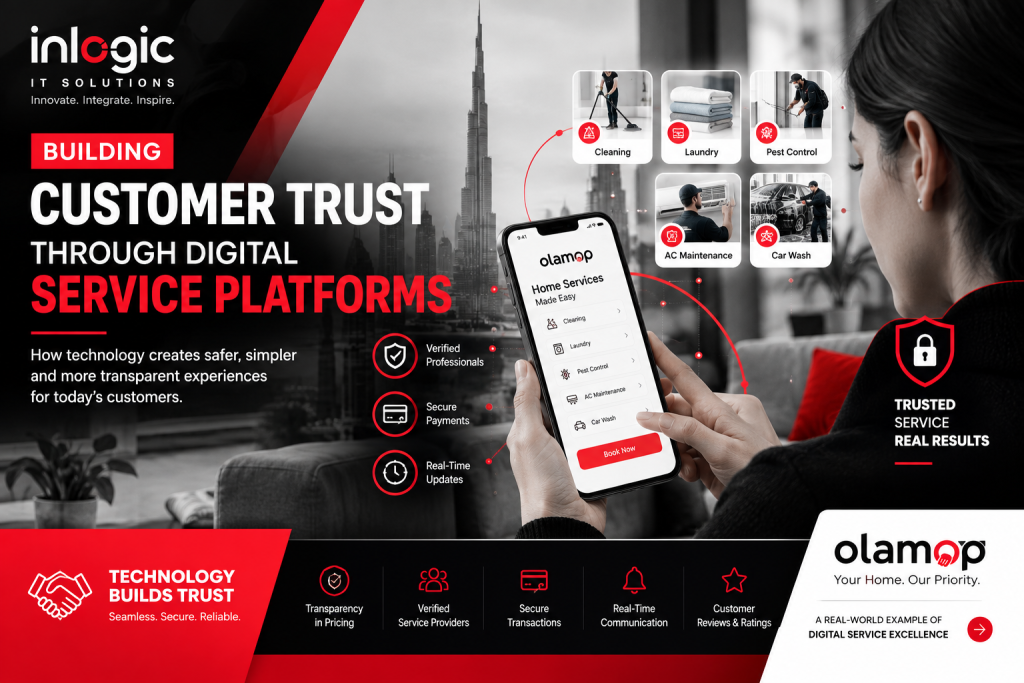
Modern digital platforms can create trust by making the customer journey more transparent, secure, convenient, and reliable. Features such as verified service providers, clear pricing, secure payments, real-time updates, and customer reviews are helping businesses build stronger relationships with their customers.
At Inlogic IT Solutions, we understand that successful digital platforms are not just about advanced technology. They are about creating experiences that customers can trust.
Why Is Customer Trust Important for Digital Platforms?
When customers interact with a business online, they cannot always physically see the people, products, or services before making a decision.
As a result, they look for signals that help them determine whether a business is trustworthy.
These signals may include:
- Clear and transparent pricing
- Secure payment methods
- Customer reviews and ratings
- Professional website and mobile application design
- Accurate service information
- Real-time communication
- Reliable customer support
- Verified service providers
A lack of transparency can quickly cause customers to leave a platform and choose a competitor.
For businesses operating digital marketplaces and service platforms, trust should therefore be considered an essential part of the technology strategy.
Transparency Creates Better Customer Experiences
One of the biggest reasons customers lose trust in online businesses is uncertainty.
They may be unsure about:
- The final price of a service
- Who will provide the service
- When the service will arrive
- What happens after payment
- How to contact the business if there is a problem
Technology can help eliminate these concerns.
A well-designed digital platform provides customers with the information they need before, during, and after completing a booking.
For example, customers can view available services, understand pricing, select their preferred appointment time, and receive confirmation immediately.
This creates a more transparent experience and reduces unnecessary confusion.
For businesses in the home services industry, platforms such as Olamop demonstrate how digital technology can simplify access to essential services by bringing booking and service management into a convenient online experience.
Secure Payments Build Digital Confidence
Payment security is another major factor in customer trust.
Customers want to know that their personal and financial information is protected when they complete a transaction online.
A reliable digital platform should therefore include secure payment technologies and follow appropriate security practices.
A strong payment experience should provide:
- Secure payment processing
- Clear transaction information
- Payment confirmation
- Protection of sensitive information
- Reliable refund and cancellation processes where applicable
When customers feel confident about making payments, they are more likely to complete a booking and return to the platform in the future.
For businesses, investing in secure technology is not only about protecting transactions. It is also about protecting their reputation.
Real-Time Updates Reduce Customer Uncertainty
Customers appreciate knowing what is happening after they make a booking.
In traditional service businesses, customers may need to call repeatedly to confirm an appointment or ask about the status of a service.
Digital platforms can automate this communication.
Real-time notifications can inform customers when:
- A booking has been confirmed
- A service provider has been assigned
- An appointment is approaching
- A service is in progress
- The service has been completed
This level of communication helps customers feel more informed and connected to the business.
It also reduces the workload for customer service teams because users can access important updates directly through the platform.
Verified Service Providers Improve Customer Confidence
Trust becomes especially important when businesses connect customers with third-party professionals or service providers.
Customers want confidence that the person arriving at their home or workplace is reliable and qualified.
Technology can support provider verification and management by maintaining accurate records and profiles within the platform.
Depending on the business model, a platform may include:
- Provider registration
- Identity verification
- Service history
- Customer ratings
- Performance monitoring
- Availability management
These systems can help businesses maintain quality standards while giving customers greater confidence in the services they book.
For home service platforms, this is particularly important because customers may be booking cleaning, maintenance, pest control, or other services that require professionals to visit their homes.
Customer Reviews Help Create Social Proof
Before making a purchasing decision, many customers look for reviews from other users.
Reviews provide valuable information about the customer experience and help people make informed decisions.
A digital platform can make this process easier by allowing customers to rate services and provide feedback after a booking is completed.
Customer reviews can benefit businesses by:
- Increasing transparency
- Building credibility
- Identifying service issues
- Encouraging service quality
- Helping new customers make decisions
However, review systems should be managed carefully.
Authentic feedback is more valuable than simply displaying positive reviews. Businesses should use customer feedback as an opportunity to identify areas for improvement and strengthen the overall customer experience.
The Role of Automation in Building Reliability
Reliability is one of the most important elements of customer trust.
Customers expect a business to deliver what it promises.
Automation helps businesses maintain consistency by reducing reliance on manual processes.
For example, automation can manage:
- Booking confirmations
- Appointment reminders
- Customer notifications
- Service assignments
- Payment updates
- Follow-up messages
- Customer feedback requests
Without automation, employees may need to perform many of these tasks manually.
As the number of customers grows, manual processes can become difficult to manage and increase the risk of mistakes.
Automation ensures that important steps happen consistently and at the right time.
This creates a more reliable customer experience while improving operational efficiency.
User Experience Can Influence Customer Trust
A poorly designed website or mobile application can affect how customers perceive a business.
If users struggle to find information, complete a booking, or make a payment, they may question the reliability of the entire platform.
Good user experience focuses on simplicity.
A digital platform should make it easy for customers to:
- Understand available services
- Find relevant information
- Complete a booking
- Manage appointments
- Make secure payments
- Contact support when necessary
Every unnecessary step can increase the chances of a customer leaving the platform.
This is why user experience design should be considered during the development of any digital product.
Technology should simplify the customer journey rather than make it more complicated.
Data Security Is Essential for Long-Term Trust
Digital platforms often collect important customer information, including names, contact details, addresses, and payment-related data.
Protecting this information is essential.
A security incident can damage customer confidence and have a long-term impact on a business.
Companies should consider security throughout the development process.
Important areas may include:
- Secure user authentication
- Data encryption
- Access management
- Secure payment integrations
- Regular system monitoring
- Software updates
- Backup and recovery systems
Cybersecurity should not be treated as an afterthought.
As digital platforms continue to collect and process more customer information, strong security practices are becoming an essential part of maintaining trust.
Personalization Without Compromising Privacy
Customers increasingly expect businesses to provide relevant and personalized experiences.
Technology and data can help businesses understand customer preferences and improve service recommendations.
For example, a digital platform may use previous booking information to help customers quickly access services they use regularly.
However, personalization must be balanced with privacy.
Businesses should be transparent about how customer data is used and avoid creating experiences that make users feel uncomfortable.
The goal should be to use technology to make services more convenient while respecting customer privacy.
Why Trust Is a Competitive Advantage
In competitive markets, customers often have multiple options.
Price and convenience are important, but trust can be the deciding factor.
A customer who trusts a platform is more likely to:
- Complete a booking
- Return for future services
- Recommend the platform
- Leave positive feedback
- Build a long-term relationship with the brand
This makes trust a valuable business asset.
Companies that invest in transparent communication, reliable technology, strong security, and excellent user experiences can build stronger relationships with their customers.
How Inlogic IT Solutions Helps Businesses Build Trusted Digital Platforms
At Inlogic IT Solutions, we develop technology solutions designed around real business requirements and customer expectations.
Our expertise includes:
- Custom software development
- Mobile application development
- Web platform development
- Secure system integration
- Business process automation
- Cloud solutions
- AI-powered technologies
- Digital transformation
We help businesses build platforms that are secure, scalable, and designed to deliver seamless customer experiences.
Whether a company is launching a home services marketplace, booking platform, customer portal, or enterprise application, technology should support both business growth and customer confidence.
By combining the right technology strategy with a strong focus on usability, security, and automation, businesses can create digital experiences that customers trust.
Frequently Asked Questions
How do digital platforms build customer trust?
Digital platforms build customer trust through transparent pricing, secure payments, verified service providers, customer reviews, reliable communication, data security, and a simple user experience.
Why is transparency important for online services?
Transparency helps customers understand pricing, service details, booking processes, and policies before making a decision. This reduces uncertainty and improves confidence in the business.
How do real-time updates improve customer experience?
Real-time updates keep customers informed about booking confirmations, appointments, service progress, and completion. This improves communication and reduces uncertainty.
Why is data security important for digital platforms?
Digital platforms often collect sensitive customer information. Strong data security helps protect this information, prevent unauthorized access, and maintain customer confidence.
Can automation improve customer trust?
Yes. Automation improves consistency by ensuring important processes such as booking confirmations, reminders, notifications, and updates happen accurately and on time.
Conclusion
Technology has transformed the way businesses build relationships with their customers.
In the digital world, trust is created through every interaction—from the first website visit to booking, payment, service delivery, and customer support.
Transparent pricing, secure payments, real-time communication, verified professionals, strong cybersecurity, and user-friendly design all contribute to a trusted digital experience.
As more businesses move their services online, companies must focus on more than simply developing a website or mobile application. They need to create digital experiences that customers feel confident using.
At Inlogic IT Solutions, we help businesses develop secure, scalable, and customer-focused digital platforms that support long-term growth.
By combining technology, automation, security, and exceptional user experience, businesses can build stronger customer relationships and crea
